
Last Articles
CAP LC Submits Written Statement to the UN Commission on the Status of Women for its 71st Session
CAP LC, a non-governmental organization in special consultative status with the United Nations Economic and Social Council, today submitted its written statement to the Secretariat of the Commission on the Status of Women. The statement was filed on the final day of the submission period for the Commission’s seventy first session, to be held from 8 to 19 March 2027 at United Nations Headquarters in New York.
Institutional Violence Against Women
The statement addresses institutional violence against women, with particular attention to mothers who report intrafamily violence and are subsequently criminalized for acts of protection. CAP LC examines the functioning of the French sociojudicial system, where protective mothers face accusatory inversion, the non-validated concept of so called parental alienation, pathologization, and secondary victimization. The statement further analyzes intersectional discrimination affecting single mothers, migrant women, and religious minorities, including the case of Romanian yoga practitioners detained in France in November 2023. It also highlights the economic dimension of these violations, noting that the pursuit of justice can itself become a pathway to poverty.
Read more here
MIVILUDES: CAP LC’s follow up report to the OSCE published at the Warsaw Human Dimension Conference
The Warsaw Human Dimension Conference
From 5 to 15 October 2026, delegations of the participating States, civil society representatives and independent experts gather in Warsaw for the annual Human Dimension Conference organized by the OSCE Office for Democratic Institutions and Human Rights, the principal human rights event of the OSCE calendar. CAP LC contributed to the conference with a report on France and the MIVILUDES, published on the OSCE website under reference CIO.WHDC.CS/0086/26/EN. The report documents the judicial sanctions pronounced against the French interministerial mission and its partner associations, and examines the structural role of the media in the stigmatization of religious minorities.
Read more here
Forced-Labor Law and Religion Collide in the US: A UN Filing Raises Alarm
A newly submitted NGO statement warns that expansive readings of trafficking legislation may place spiritual communities at risk.
Two NGOs (CADD and CAP-LC) warned the UN Human Rights Council that U.S. forced-labor law is expanding into religious communities. In the OneTaste case, prosecutors treated psychological and spiritual pressure as forced labor even though participants were free to leave. The NGOs argue this risks criminalizing ordinary religious discipline and voluntary communal life. They urge Congress, during TVPA reauthorization, to clarify that genuine religious practices are not “serious harm” and to bar discredited “brainwashing” theories from federal training.
Read the full article here by Massimo Introvigne
Sacred Eroticism, Anti Cultism, and the Revival of “Brainwashing” Narratives: An Emic View
EUARE session: ARE ”BRAINWASHING” THEORIES COMING BACK? RENEWED TRANS-NATIONAL ANTI-CULT ACTIVISM
European Academy of Religion had its Ninth Annual Conference, in Rome, Italy, June 30 – July 3, 2026.
The conference program comprise panels and keynote lectures focusing on the overarching topic, Religions and (in)equalities.
In the session: ARE "BRAINWASHING" THEORIES COMING BACK? RENEWED TRANS-NATIONAL ANTI-CULT ACTIVISM,Camelia Marin, Soteria International - Deputy Director, examined the resurgence of anti‑cult rhetoric in Europe and its impact on minority spiritualities, particularly those practicing sacred or holy eroticism. Despite the rejection of “brainwashing” theories by mainstream psychology and sociology, anti‑cult networks have successfully re‑engineered these narratives into potent legal and political tools. Through case studies such as the Movement for Spiritual Integration into the Absolute (MISA), the paper demonstrates how apostates, media sensationalism, and theatrical police raids construct moral panics that criminalize consensual esoteric practices. The analysis situates these dynamics within a broader historical continuum, recalling the persecution of the Cathars and other minority faiths, and highlights the paradox whereby secular societies celebrate sexual experimentation yet repress identical behaviors when embedded in spiritual frameworks. Drawing on comparative religious traditions—Hinduism, Christianity, Judaism, and Islam—the article shows that consecration and bodily ritual have long been central to spiritual life. Scholarly perspectives from Mircea Eliade, John Woodroffe, and William James further validate the transformative, non‑pathological nature of mystical erotic states. Ultimately, the paper argues that sacred eroticism represents a legitimate, historically grounded, and legally protected path of human flourishing. It calls for a mature, inclusive discourse that dismantles weaponized anti‑cult taboos and affirms freedom of conscience as a fundamental human right.
Human Rights and Perspectives In and Out of Spiritual Communities
Conference - Friday, 12th of June 2026 from 10.00 – 12.00 CET
Soteria International, in collaboration with: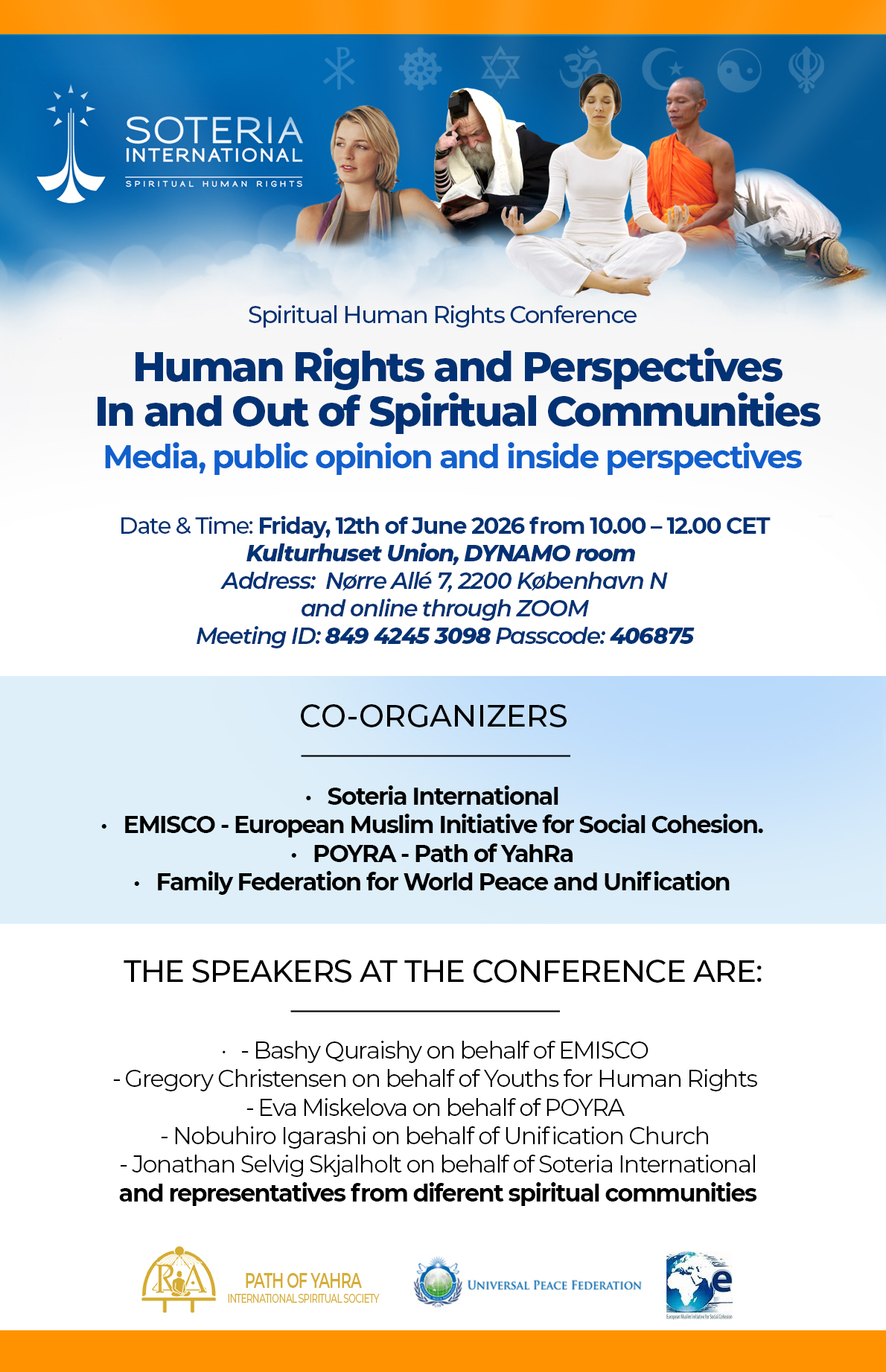
EMISCO - European Muslim Initiative for Social Cohesion.
POYRA - Path of YahRa
Family Federation for World Peace and Unification
Invite you to the following conference:
Human Rights and Perspectives In and Out of Spiritual Communities
Date & Time: Friday, 12th of June 2026 from 10.00 – 12.00 CET
Venue: Kulturhuset Union, DYNAMO room
Address: Nørre Allé 7, 2200 København N
and ONLINE through ZOOM.
Working in the field of freedom of religion and belief, we encounter multiple cases worldwide in which spiritual belief systems, groups or religious practices are restricted or even shut down by national law, fueled by media campaigns that foster societal prejudices and misconceptions.
This is influencing, to a major extent, each individual's ability to exercise freedom of religion and belief, since their perspective on various spiritual and religious groups will inevitably be coloured by how the media presents them. This challenge of spirituality and religion is what we aim to address in this conference.
Recovering the Soul of Human Rights
Article by Peter Zoehrer.
He is a writer and independent thinker focused on human rights, ethics, and the moral foundations of democratic society. His work explores the philosophical and spiritual dimensions of human dignity, often examining how modern institutions can reconnect with the original human-centered values behind rights discourse. Through reflective essays and commentary, he advocates for a more compassionate, culturally grounded, and universally meaningful understanding of human rights.
Peter Zoehrer brings a valuable perspetive to the field of human rights. Read his recent article here.
The Tokyo High Court Unification Church Decision. 1. A Caricatural View of the Church
The court reconstructed the theology and practices of the movement founded by Reverend Moon based on selective quotes and hostile sources.
By Massimo Introvigne
On March 4, the Tokyo High Court announced its decision to uphold the Tokyo District Court’s verdict ordering the dissolution of the Family Federation for World Peace and Unification (formerly known as the Unification Church and still often referred to by that name) as a religious corporation. What follows is an analysis of the voluminous decision. The text is often repetitive, and my analysis proceeds by examining its six main themes rather than following its arguments in the order in which they are presented.
Read the full article here
Tokyo High Court’s Blatant Ideological Hit Job on the Unification Church
A dangerous precedent that threatens religious liberty worldwide
By Peter Zoehrer
On March 4, 2026, the Tokyo High Court, under Presiding Judge Motoko Miki, upheld the dissolution of the Family Federation for World Peace and Unification (formerly the Unification Church) as a religious corporation. Liquidation proceedings began immediately. This marks Japan’s first-ever dissolution of a religious group based primarily on civil tort claims and alleged violations of vague “public welfare” standards—without a single criminal conviction.
Read full article here
Between Law and Reality: Media and Religious Discrimination
When religious freedom faces a new threat in media reports that obscure and distort reality
by Marco Respinti
Media institutions undeniably wield substantial influence in religious liberty. The general public can, in fact, become aware of human rights violations worldwide—particularly in uncommon or sensitive contexts—only through media reporting. This primary responsibility of the media, however, becomes culpability when inaccurate or deliberately misleading coverage distorts public understanding of religious phenomena. Persistent misrepresentation and selective framing shape societal perceptions and produce especially detrimental effects on religious minorities, which consequently suffer a double injustice: first, from the violations they endure, and second, from the gratuitous stigma generated by superficial or hostile media portrayals. Moreover, the consequences of media distortions extend far beyond the audiences who read newspapers, watch TV, listen to radio shows, or follow online media. They shape policymakers’ attitudes, institutional responses, and ultimately the formulation of policy itself.
Read the full article here
Interfaith Cooperation in Advancing Peace in the World - Copenhagen, Denmark.
On February 1st 2026, Soteria participated in the “Interfaith Cooperation in Advancing Peace in the World”. The first speaker, Fakhra Sheheen from the Immigrant Museum in Farum, Denmark, emphasised the importance of historical documentation and underscored that this documentation must not be limited to the media and social media. She offered glimpses into the museum’s collection as inspiring examples. Fakhra underlined the importance of standing up for values and actively defending them so they are not forgotten.

